Industry
Copper Components for Power and Energy Equipment
Custom copper components for power and energy equipment, matched to confirmed circuit, current path, joints, thermal limits, insulation, cooling, geometry, and inspection.
Industry Scope
Winworth manufactures drawing-based copper and copper-alloy components for selected current-transfer, contact, terminal, bus, clamping, and water-cooled positions in industrial power and energy equipment. The page routes inquiries to an application and product family; it does not define a standard electrical assembly.
Equipment context may include furnace secondary circuits, electrode systems, resistance-welding equipment, industrial bus connections, low-voltage distribution assemblies, electrical cabinets, and other buyer-defined high-current equipment. Each inquiry is controlled by the actual circuit, equipment function, voltage class, current and frequency data supplied by the buyer, duty, cooling, insulation, mechanical interfaces, and governing standard.
Application and Product Routing
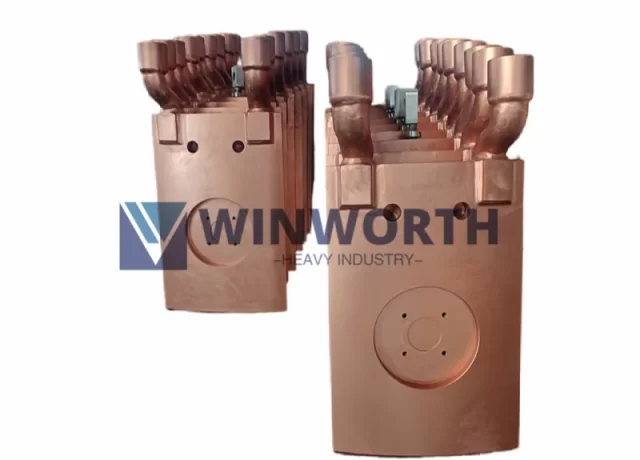
High-Current Connection covers the interface between conductors and equipment, including drawing-defined contact shoes, clamps, pads, rings, terminals, connector blocks, and flexible or rigid conductive links. Similar appearance does not make these components interchangeable across furnaces, welding machines, cabinets, or other equipment.
Busbar / Electrical Cabinet System covers manufactured busbars, conductive plates, terminals, links, supports, and cabinet conductors. Winworth supplies the ordered copper component; the assembly designer remains responsible for circuit rating, short-circuit withstand, clearances, creepage, insulation coordination, protection, enclosure, ventilation, earthing, and conformity of the complete assembly.
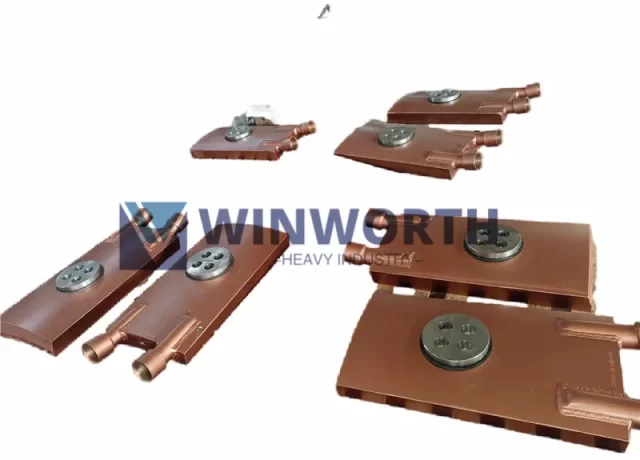
Water-Cooled Power Components covers flexible water-cooled cables and buyer-defined cooled terminals or conductors. It does not combine every cooled part into one product or include the complete cooling-water plant, monitoring, interlocks, electrical protection, or moving equipment.
Electrical, Thermal, Mechanical, and Cooling Inputs
Provide AC or DC system, rated and operating voltage and current, frequency and waveform, phase arrangement, duty cycle, current path, joint sequence, parallel conductor arrangement, prospective fault and short-circuit inputs supplied by the buyer, permissible temperature limits, ambient and enclosure conditions, ventilation, nearby heat sources, electromagnetic forces, vibration, movement, and maintenance method.
For cooled components, also provide coolant specification, inlet temperature, permitted outlet temperature or temperature rise, flow, pressure, pressure drop, circuit map, water quality, hose and fitting requirements, electrical isolation, leakage detection, monitoring, interlocks, draining, flushing, and test procedure.
Material grade, condition, conductivity, mechanical properties, section, geometry, bends, holes, contact surfaces, plating or coating, insulation, supports, fasteners, joining, and heat treatment follow the approved design. Cross-sectional area alone does not establish ampacity or system performance.
Engineering, Inspection, and RFQ Information
Provide the single-line and assembly drawings, part drawing and revision, equipment maker and model, ordered component and supply boundary, electrical and thermal inputs supplied by the buyer, material and condition, geometry, joint and contact requirements, fasteners and torque specification, support and movement, insulation, cooling circuit, tolerances, surface finish, plating, NDT and tests, quantity, records, packaging, destination, and requested delivery schedule.
Inspection may include material verification, conductivity or mechanical-property tests when ordered, dimensions and datums, bend and hole pattern, contact-face flatness and finish, plating thickness or coverage, joints, passage mapping, pressure or leakage testing, electrical resistance checks under an agreed method, insulation checks within the ordered scope, trial assembly, marking, and document review.
No ampacity, contact resistance, temperature rise, short-circuit withstand, dielectric performance, power loss, cooling capacity, equipment efficiency, service interval, or life is promised without validated system inputs and agreed acceptance criteria.