Application
Components for Conveying and Wear Systems
Drawing-based components for conveyors, feeders, chutes, hoppers, and transfer points, matched to flow, wear zone, interfaces, fastening, material, fit, and inspection.
Application Scope and System Boundary
Winworth manufactures drawing-based liners, plates, bushings, sleeves, and selected custom components for confirmed positions in bulk-material conveying and wear-protection systems. Typical contexts include conveyors, feeders, loading zones, hoppers, bins, chutes, discharge boxes, and transfer points.
Conveying and wear protection are related but distinct. A conveyor moves material through belts, chains, pans, rollers, pulleys, drives, structures, and controls. Wear liners protect surfaces exposed to impact, sliding, abrasion, sticking, corrosion, or material flow. The ordered Winworth part does not automatically include either complete system.
Flow, Impact, and Installation Inputs
Provide the equipment and transfer-point arrangement, material type, bulk density, lump size, moisture, temperature, abrasiveness, stickiness, corrosive exposure, contamination, flow direction, drop height, impact zone, velocity data supplied by the buyer, buildup, blockage, dust, spillage, and cleanout method.
For a liner or wear plate, identify the exact chute, hopper, skirt, loading, discharge, or transfer position; original profile and thickness; backing; support; fasteners; seams; overlap; edge condition; flow direction; installation access; lifting; removal sequence; and whether the part is sacrificial, structural, or both. Do not infer chute geometry or flow performance from one liner.
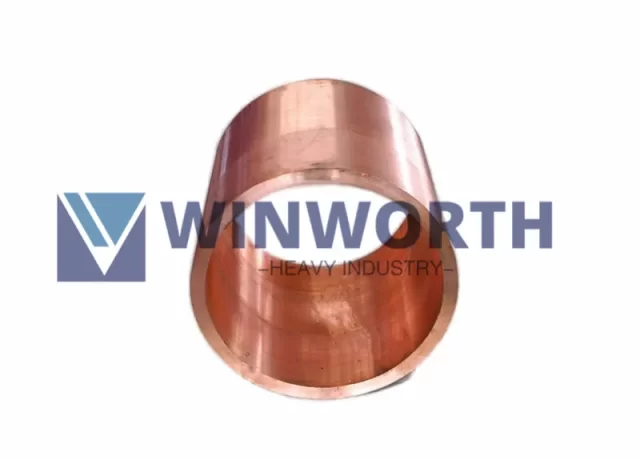
For a bushing or sleeve, identify the shaft, pin, housing, or pivot; load and motion; speed or oscillation; lubrication; contamination; fit; clearance; retention; flange, groove, or hole features; mating materials; and replacement method. A bushing is not a conveyor idler, roller, pulley, bearing assembly, drive, or belt component.
Material, Manufacturing, and Inspection
Material may be buyer-specified metallic alloy, copper alloy, steel, or another approved solution appropriate to the component. The drawing must state material and condition, manufacturing route, heat treatment, hardness or property requirements, fastening and joining, coating or surface treatment, machining, and inspection. Winworth does not assume that one material fits every impact, abrasion, corrosion, noise, friction, or temperature condition.
Inspection may include material records, dimensions and datums, profile or template checks, thickness, flatness, curvature, fit, fastener and hole pattern, hardness mapping, specified NDT, weld inspection, coating, surface condition, trial assembly, marking, and documentation.
No material-flow improvement, dust reduction, belt protection, power saving, throughput, liner life, conveyor availability, or maintenance reduction is promised without a complete system review and agreed acceptance criteria.
RFQ Information
Provide equipment and position, process-flow or assembly drawing, part drawing and revision, material handled and operating data, wear observations and photographs, original and requested material, backing and support, fasteners, mating dimensions, fits and tolerances, installation and removal method, manufacturing route, heat treatment, NDT and inspection, quantity, records, packaging, lifting, and destination.