Application
Copper Components for High-Current Connections
Drawing-based copper components for high-current connections, matched to equipment, current path, contact interfaces, mechanical loads, cooling, insulation, and tests.
Application Scope and Current Path
Winworth manufactures drawing-based copper and copper-alloy components for selected high-current connection positions. The component may form a fixed joint, bolted interface, sliding or clamped contact, terminal, flexible link, bus connection, or cooled conductor, but its role must be confirmed from the complete circuit and assembly drawing.
Map the current path from the upstream conductor to the ordered component, contact or joint, downstream conductor, load, and return path. Identify phase, polarity, parallel paths, flexible and fixed sections, moving interfaces, insulation boundaries, supports, cooling, instrumentation, and maintenance isolation.
Product Identity and Interface Review
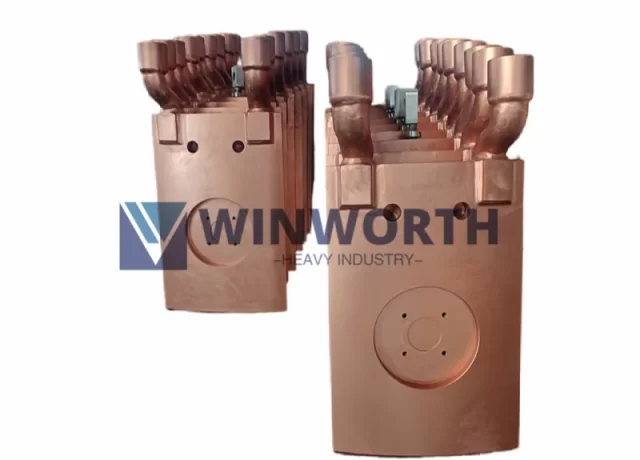
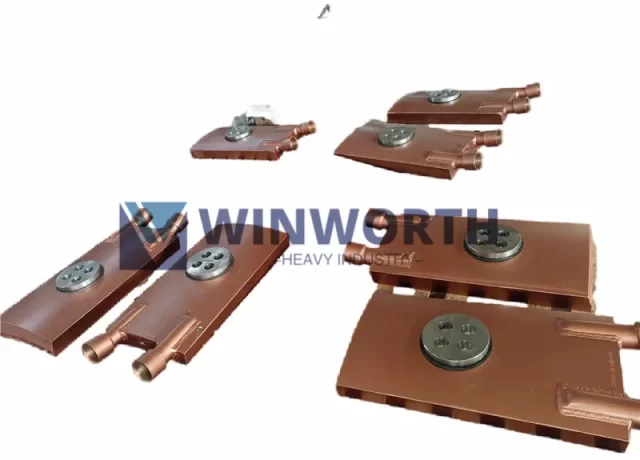
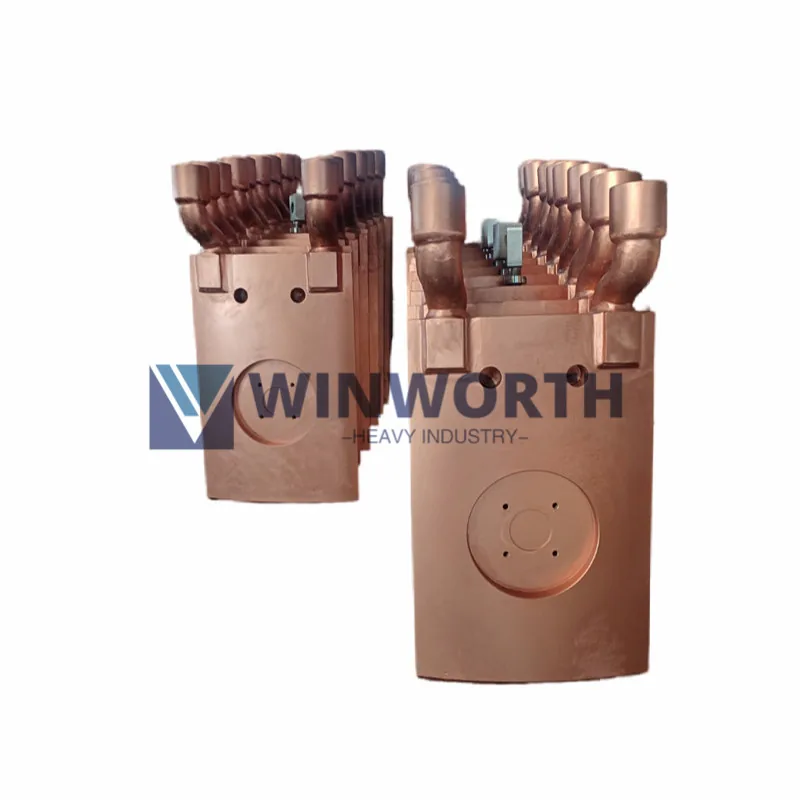
A SAF contact shoe transfers current to an electrode through a pressure-controlled contact interface. A SAF pressure ring transfers clamping action and is not itself another name for the shoe. An EAF clamp/holder combines a different electrode interface and mechanical role. Welding contact pads and CuCrZr contact rings serve separate resistance-welding or drawing-defined contact positions. A water-cooled power cable is the flexible connection in a furnace secondary circuit.
These products may share copper material and high-current duty, but they do not share geometry, pressure, movement, cooling, insulation, or acceptance criteria. Select the product route by equipment function and drawing, not by a generic "high-current copper part" label.
Joint, Contact, and Mechanical Inputs
Provide rated and operating current and voltage supplied by the buyer, AC or DC, frequency and waveform, duty cycle, joint type, contact area and pressure, mating material, surface finish, plating, flatness, bolt pattern, fastener grade, washer arrangement, tightening or torque procedure, allowable movement, thermal expansion, supports, vibration, electromagnetic load, ambient heat, contamination, oxidation, and maintenance access.
Contact performance belongs to the assembled joint. Material conductivity alone does not determine joint resistance or temperature rise. Surface preparation, flatness, pressure distribution, fasteners, plating, oxidation, contamination, assembly method, parallel paths, heat dissipation, and operating environment must be considered together.
Material, Manufacturing, Inspection, and RFQ
Material and condition follow the approved drawing and property requirements. Manufacturing may include forged, rolled, cast, extruded, machined, drilled, bent, formed, welded, brazed, crimped, plated, coated, or assembled construction as applicable to the component. Joining and heat input must not be changed without review of conductivity, mechanical properties, flexibility, and dimensional stability.
Inspection may include material and conductivity records, dimensions and datums, contact-face flatness and finish, bend and hole geometry, joint and termination checks, plating, specified NDT, passage and leakage tests for cooled parts, resistance checks under an agreed fixture and method, insulation checks within scope, fit or trial assembly, and documentation.
Provide circuit and assembly drawings, equipment and component function, electrical inputs, joint and contact requirements, material and condition, manufacturing route, interfaces, pressure or clamping arrangement, fasteners and assembly procedure, cooling and insulation, tolerances, surface treatment, tests, quantity, records, packaging, and destination.
No current-carrying capacity, contact resistance, temperature rise, electrodynamic withstand, short-circuit rating, electrical efficiency, or service life is inferred from the component name or copper grade.