
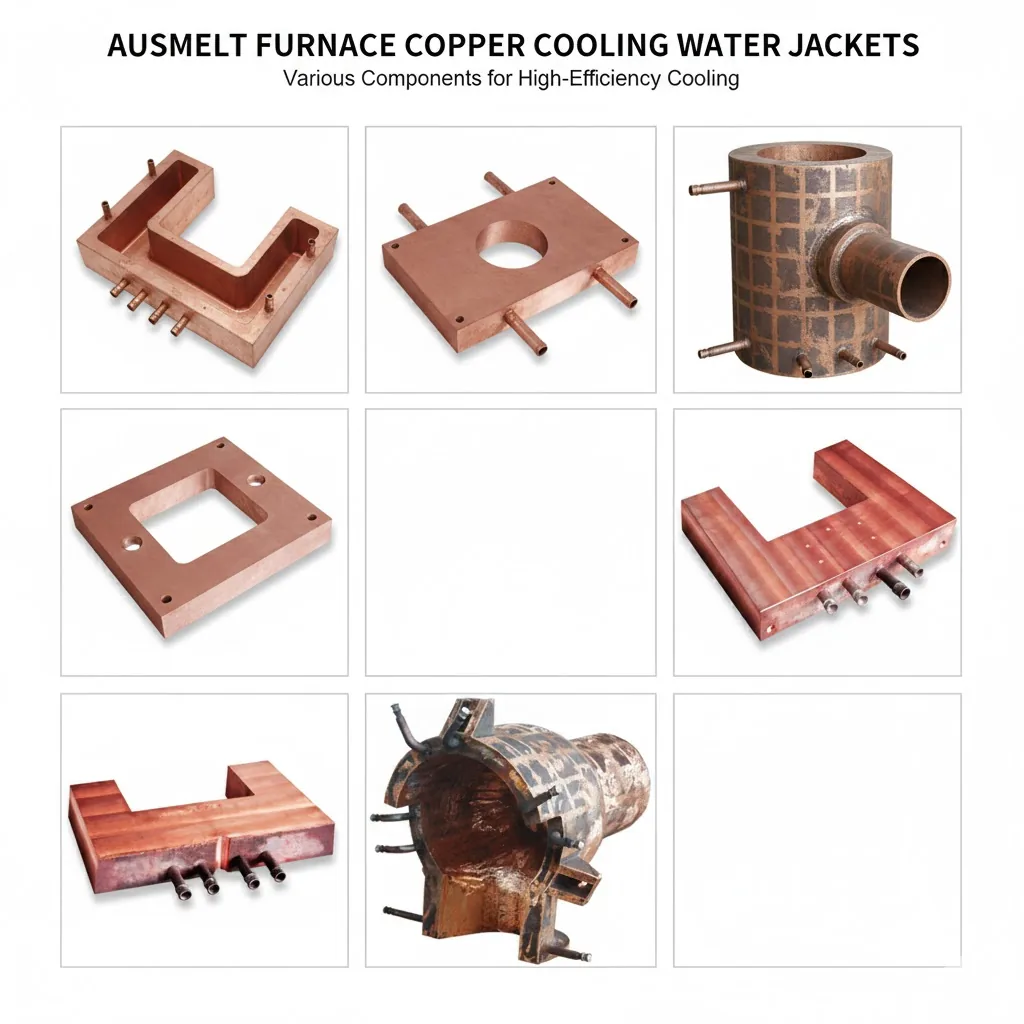
Purchase the Installed Cooling Function, Not a Generic Copper Part
Copper cooling plates, panels, water jackets, staves, blocks, rings, and other water-cooled components are pressure-carrying thermal assemblies installed inside a larger system. A finished-shape drawing without circuit, interface, operating, inspection, and documentation requirements is rarely a complete purchase definition.
1. Identify the Exact Equipment Position
- Equipment, furnace or line, component name, tag, installed position, orientation, quantity, left/right or mirrored condition, and interchangeability.
- New design, repeat order, replacement from approved drawing, reverse-engineered replacement, repair, or design review.
- Drawing numbers, revisions, 3D models, legacy samples, field measurements, photographs, and which source controls when they disagree.
- Adjacent refractory, shell, frame, piping, buswork, moving parts, process zone, access, installation sequence, and removal envelope.
A legacy sample can help confirm interfaces and wear, but wear, distortion, repairs, deposits, and measurement uncertainty must not silently become the new design.
2. Define Thermal and Hydraulic Inputs
- Process-side heat source, duty cycle, expected transient events, hot-face zones, refractory relationship, and known local damage history.
- Cooling medium, design and operating inlet conditions, return condition, available pressure, required or expected flow, temperature rise, water quality, filtration, and control philosophy.
- Circuit arrangement, passage geometry, parallel or series branches, manifolds, connections, vents, drains, high points, low points, flow direction, and instrument locations.
- Design, operating, test, trip, and alarm conditions must be labelled separately.
Winworth can review manufacturability and the component drawing, but system-level hydraulic, thermal, pressure-boundary, safety, and code approval remain controlled by the equipment owner and responsible engineer.
3. Freeze Interfaces and Configuration
Control overall envelope, datums, mounting faces, holes, studs, flanges, sealing faces, thread standard, pipe and hose connections, orientation, clearances, tolerances, surface finish, flatness, alignment, lifting points, replaceable inserts, and traceability-mark location.
Mark characteristics as:
- fixed and acceptance-critical;
- target values with an approved tolerance;
- reference information only;
- open to a documented manufacturing proposal.
Configuration control should cover drawings, models, bills of material, circuit diagrams, inspection plans, concessions, repairs, and as-built records.
4. Specify Material and Manufacturing Route
State the exact copper or copper-alloy designation, governing standard, product form, condition or temper, and required properties. Then define or approve the feasible route, which may include cast, forged, rolled, extruded, machined, drilled, slotted and closed, fabricated and welded, brazed, or a qualified combination.
The material name alone does not define:
- internal soundness or surface condition;
- section transitions and minimum wall after manufacture;
- weld, braze, plug, or closure design;
- heat treatment and sequence;
- machining allowance and datum transfer;
- repair permission and approval;
- cleanliness of the completed water circuit.
Alternative material, route, joint, or geometry requires visible technical approval before production.
5. Define Inspection and Test Boundaries
- Material identity, traceability, dimensional stages, wall checks, surface condition, channel inspection, and cleanliness.
- Applicable UT, PT, radiography, visual, conductivity, hardness, chemistry, mechanical, metallographic, or other tests only where technically suitable and specified.
- Procedure, stage, coverage, sensitivity or measurement method, personnel requirement, acceptance criteria, report, witness, and hold points.
- Pressure or leak test medium, test boundary, preparation, defined pressure, duration, temperature, acceptance, drying, cleanliness, safety, and report.
A component pressure or leak test does not validate the complete installed cooling system, flow distribution, thermal performance, external piping, controls, or site safety case.
6. Define Documentation and Change Control
Agree the required document package before quotation:
- approved drawings and as-built drawing;
- material certificates and traceability map;
- manufacturing, joining, heat-treatment, and repair records when required;
- dimensional and inspection reports;
- pressure or leak-test report;
- concessions, deviations, and buyer approvals;
- packing list, package photographs, lifting and unpacking instructions.
Define document language, format, approval timing, retention, and whether a manufacturing data book is required. "Standard documents" is not a reproducible scope.
7. Include Export Packaging and Receiving
State component mass and center of gravity, lifting points, vulnerable surfaces and fittings, water-channel cleanliness and closure, corrosion or moisture protection, crate or skid limits, wood-packaging requirements, markings, destination, transport mode, storage, and receiving inspection.
Compare quotations on the same technical and commercial basis: component scope, material, manufacturing route, tooling, inspection, documentation, packing, freight responsibility, quantity, schedule assumptions, exclusions, and change process. There is no universal MOQ or lead time for custom copper cooling assemblies.